How hard is a beginner's ice climb on Solheimajokull?
Both tours on this site say a beginner needs no experience, and the guide fits every piece of gear. That does not make the climb effortless. Your arms tire quickly while your legs do the real work, and walking on crampons takes a few minutes to trust.
No experience needed, but some effort
Neither Arctic Adventures nor Tröll Expeditions asks for climbing experience. The guide teaches the basics on the day and fits the gear, then stays with the group, so a first-timer is the normal customer.
Ice climbing is still a physical activity on a moving glacier, and nobody should call it risk-free. Glaciers hold crevasses and moulins, which is why you only go onto the ice with a certified guide and never on your own.
What the gear does for you
You wear a harness and a helmet, with crampons strapped to your boots and an ice axe in each hand on the wall. The guide rigs the rope system before anyone climbs.
The rope runs from your harness up to an anchor above the wall and back down to the person holding it. If you slip, the rope catches you within a short distance, and the guide lowers you when you are done.
On Tröll Expeditions' climb, from ~$229, the guide sets up the system and you climb the ice walls under guidance. On Arctic Adventures the guide teaches how to use the axe and go up a natural ice wall.
Legs climb, arms hold
Beginners try to pull themselves up with the axes, and their forearms burn within a minute. What works is kicking the front points of the crampons into the ice and standing up on your legs.
Think of the axes as handholds you place, not ropes you haul on. Place an axe, kick in both feet, then stand up before moving the next axe. Keeping your arms fairly straight saves a lot of grip.
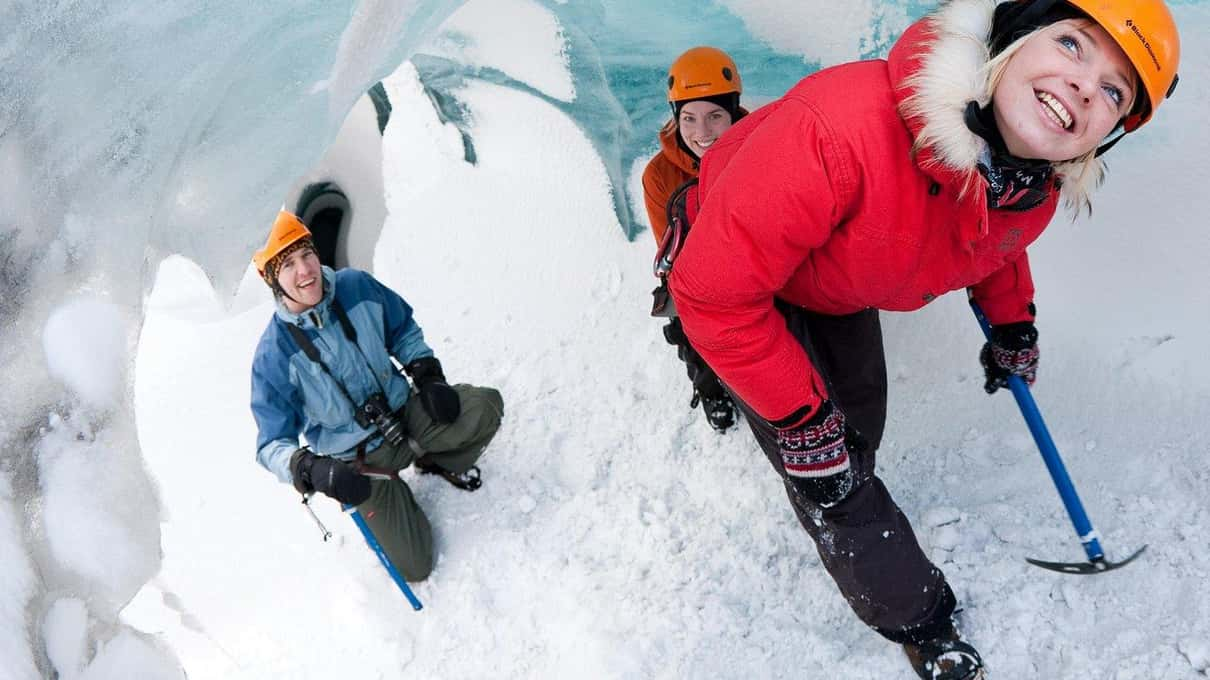
The walls are short, and you rest between turns while others climb. Most people get a few goes, though neither listing gives a fixed number, and the guide picks the wall on the day.
A first climb with time to warm up
Arctic Adventures' day starts with a hike to the ice, which gets you used to crampons before the climbing intro. The climbing is optional, so you can stop at any point and keep walking.
Walking on crampons
Before you climb, you walk. The glacier surface is uneven with ridges and dips, all streaked by volcanic ash, and the first steps on crampons feel odd for everyone.
The guide shows you how to walk with your feet a little wider than usual and to plant the whole sole flat. Lift your feet clear so the points do not catch your trousers, and uphill becomes much easier than it looks.
Arctic Adventures' tour, from ~$203, also includes a hike up a moss-covered valley to reach the ice from above. That adds distance and some climbing on foot, so the day asks more of your legs than Tröll's four hours do.
The ice changes from week to week
How hard the climb feels also depends on the glacier. The guide picks the route and the wall on the day, and a face that was steep last week may have melted back or split by now.
Summer ice tends to be wetter and softer on the surface, while winter ice is harder and often bluer. Wind and rain can make the same wall feel tougher, and bad weather can stop a tour altogether.
Fear of heights and stopping halfway
The walls are not tall, but looking down from a vertical sheet of ice still unsettles some people. You are on the rope the whole time, and you can ask to come down at any point.
The guide lowers you gently and nobody minds. On Arctic Adventures the climb is optional, so a nervous member of the group can watch from the bottom and still have the full glacier hike.
Some people find the second climb easier than the first, once they trust the rope. If you are unsure whether you want the rope at all, our page on ice climbing or a glacier hike explains what the climb adds and what a walk alone gives you.
Who should think twice
- Children under 14 on Arctic Adventures, or under 12 on Tröll Expeditions
- Anyone with a shoe size below EU 35 on Arctic Adventures
- Pregnant travelers and people with mobility impairments (Arctic Adventures lists both as not suitable)
- Anyone with a recent knee or ankle injury, or a shoulder injury
A reasonable everyday fitness is enough for most people. If you can walk uphill for half an hour without stopping, you will cope with the walk, and the climb is short bursts with rests.
Families with mixed ages should look at the limits closely. Our page comparing Arctic Adventures or Tröll Expeditions sets the age limits and group sizes side by side.
How to prepare
You do not need to train for a beginner's climb. A few walks in your hiking boots before the trip help, because blisters on the ice make a long day longer.
Gloves matter more than strength. Tröll's listing calls them necessary to protect your hands, and wet ice soaks thin ones, so bring a spare pair; our clothing guide covers the rest.
Eat before you start and carry a snack, since neither tour includes a meal. A Solheimajokull ice climbing tour in cold wind uses more energy than you expect, and the best time to climb page explains how the seasons change the ice.